On June 27, 2021 Kerry Sluchinski presented on The Other’s Other: A comparative discursive pragmatic approach to third person referential forms in digital Korean and Japanese Comfort Women discourses. The presentation focused on the translation, from Korean to Japanese, of third person referential forms used to call Comfort Women and the role this translation plays in identity construction and how it reflects attitudes towards Comfort Women at the 17th International Pragmatics Conference (IPrA 17th).
The study focused on the two following research questions:
- What third person referential forms (i.e. words used to call people/things) are used?
- A) In Source Text contexts (i.e. native usage; Korean language)
- B) In Target Text contexts (i.e. translation usage; Japanese language)
- How are the referential forms in 1a manipulated (or not) in the context of 1b?
The presentation illustrated four types of manipulation through qualitative examples:
- Unmodified (the Source Text and Target Text term match)
- Morphological manipulation (the Target Text term adds or subtracts one or more morphemes from the Source Text term)
- Honorific manipulation (both Japanese and Korean are languages that use honorifics; in this case, the Target Text term adds or subtracts honorifics from the Source Text term)
- Word Replacement (the Target Text word is completely different from the Source Text word)

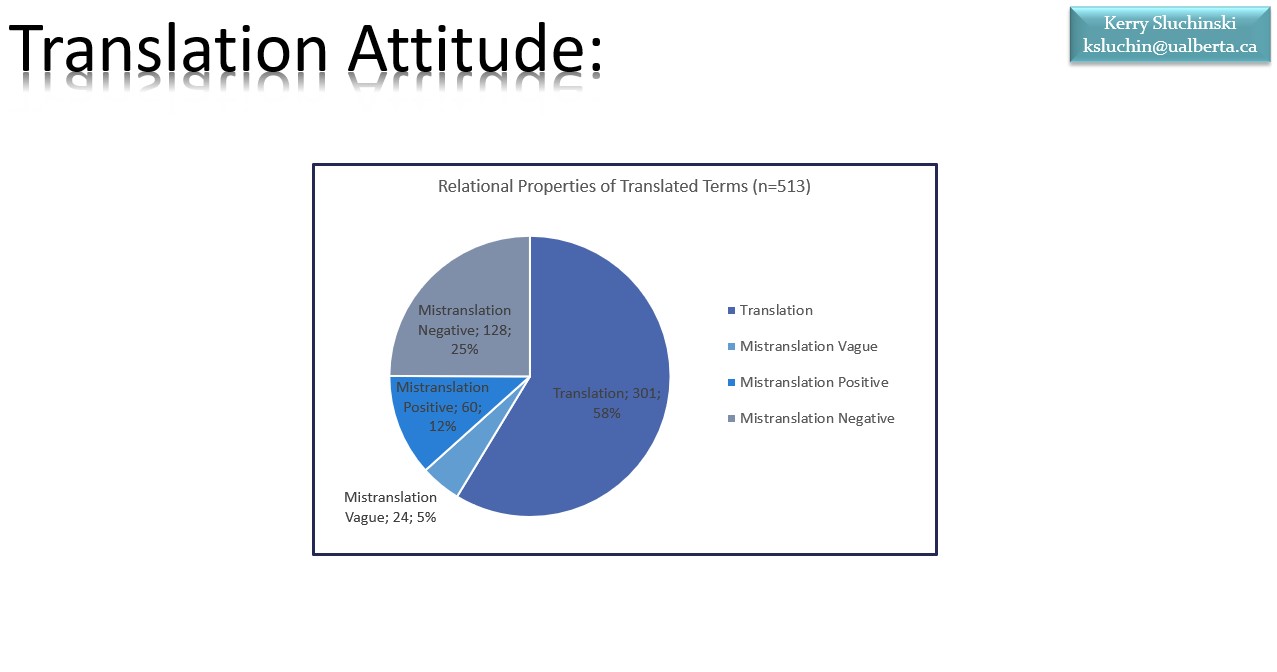
The presentation also illustrated four types of attitudes through qualitative examples and quantitative representation:
- Neutral Attitude (i.e. the Source Text term and Target Text term matched each other)
- Negative Attitude (i.e. the Target Text term was more offensive than the Source Text term; e.g. ‘woman’ translated as ‘whore’)
- Positive Attitude (i.e. the Target Text term was less offensive than the Source Text term; e.g. ‘prostitute’ translated as ‘Comfort Woman’)
- Vague Attitude (i.e. the Target Text term was neither less nor more offensive than the Source Text term but it was different; e.g. ‘girl‘ translated as ‘woman‘ )
*Attitudes 2-4 are considered as rendered through Mistranslation, a term used to describe an unfaithfully translated portion of text.
 Kerry Sluchinski | 秦克里